A Symbol That Sparks Curiosity Wherever It Appears
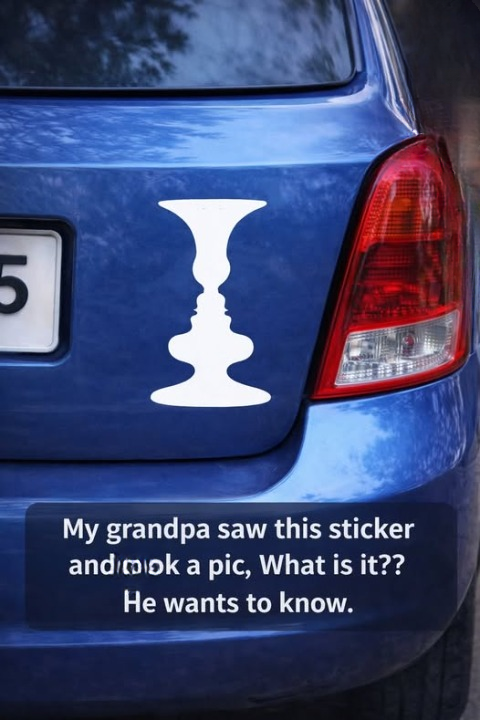
Have you ever noticed a simple white sticker on the back of a car and wondered what it meant? At first glance, it may look like a company logo, a decorative graphic, or perhaps a symbol connected to a particular organization. Many drivers and pedestrians pass by it without giving it much thought.
However, those who take a closer look often discover something surprising.
The design is actually one of the most famous visual illusions ever created. Depending on how you view it, the image can appear as either two human faces looking at each other or a decorative vase positioned in the center. This remarkable image has fascinated psychologists, artists, teachers, and curious observers for more than a century.
What makes this simple design so captivating is that it reveals something important about how our brains process information. It demonstrates that perception is not always as straightforward as we might assume.
The next time you spot this sticker on a vehicle, you’ll know that you’re looking at far more than a decorative graphic—you’re seeing a piece of psychological history.
The Famous Faces-or-Vase Illusion
The image is commonly known as the “Faces or Vase” illusion, though it is also referred to as the Rubin Vase.
At first glance, many people immediately notice a white vase standing in the middle of a black background. Others instantly see two black facial profiles facing one another.
What makes the image unique is that both interpretations exist simultaneously. The brain can switch back and forth between seeing the vase and seeing the faces, but it often struggles to focus on both at exactly the same time.
This characteristic has made the image one of the most widely studied examples of visual perception in psychology.
The illusion appears simple, yet it reveals complex processes occurring inside the human mind every second of every day.
Who Created the Design?
The image is generally credited to Danish psychologist and artist Edgar Rubin.
Rubin introduced the image in the early twentieth century while researching visual perception and cognitive psychology.
His work focused on understanding how humans distinguish objects from their backgrounds. This process might seem automatic, but it involves sophisticated mental mechanisms that help us interpret the world around us.
The Rubin Vase became one of the most famous demonstrations of this concept.
Even today, psychology students around the world encounter the image when learning about perception and visual cognition.
Why Does the Illusion Work?
The secret behind the illusion lies in a psychological principle known as figure-ground perception.
Whenever we observe a scene, our brains automatically separate visual information into two categories:
- The figure (the object we focus on)
- The background (everything surrounding it)
In everyday life, this process helps us navigate our environment efficiently.
For example, when reading text, the letters become the figure while the page becomes the background. When watching a person walk across a park, the person becomes the figure while the landscape becomes the background.
The Faces-or-Vase illusion deliberately blurs this distinction.
The white area can be interpreted as the primary object—a vase—while the black areas become the background.
Alternatively, the black areas can become the figures—two facial profiles—while the white area becomes the background.
Because both interpretations are equally valid, the brain continually shifts between them.
What the Illusion Teaches Us About Perception
One reason the image remains popular is that it demonstrates an important truth:
What we see is not always determined solely by our eyes.
Instead, perception involves active interpretation by the brain.
Our minds constantly organize information, fill in missing details, and prioritize certain elements over others.
The Faces-or-Vase illusion reveals this process in action.
Two people can look at the exact same image and notice different things first.
Neither person is wrong.
They are simply processing the information differently.
This concept has fascinated researchers for decades because it highlights the role of cognition in shaping human experience.
Why Is the Sticker Found on Cars?
Many people are surprised to learn that the symbol is often displayed simply because its owner finds it interesting.
Unlike many automotive decals, it typically does not represent a specific club, company, or organization.
Instead, it often serves as:
- A conversation starter
- An artistic expression
- A psychology-themed graphic
- A symbol of perspective and open-mindedness
- A decorative visual illusion
Some drivers enjoy displaying images that spark curiosity and encourage discussion.
The Faces-or-Vase design does exactly that.
People frequently ask questions about it, leading to interesting conversations about perception, psychology, and visual art.
The Symbol’s Popularity in Modern Culture
Over the years, the illusion has appeared in many different forms.
It can be found in:
- Books
- Educational materials
- Psychology classrooms
- Art galleries
- Graphic design projects
- Marketing campaigns
- Social media posts
- Home décor
- Vehicle decals
Its enduring popularity stems from its simplicity.
Unlike many complex works of art, the illusion requires no explanation to capture attention.
People naturally become curious when they realize the image contains more than one interpretation.
That moment of discovery creates a memorable experience.
A Powerful Lesson About Perspective
Beyond psychology, many people view the symbol as a metaphor for life.
The image reminds us that different perspectives can exist simultaneously.
Just as one person sees a vase while another sees two faces, individuals may interpret situations differently based on their experiences, beliefs, and backgrounds.
This idea has made the illusion popular among educators, speakers, and creative professionals.
It serves as a visual reminder that there is often more than one way to understand a situation.
Looking beyond our initial assumptions can sometimes reveal an entirely new perspective.
Why the Human Brain Loves Patterns
Humans are naturally wired to recognize patterns.
This ability helped our ancestors identify opportunities and avoid potential dangers.
Even today, our brains constantly search for recognizable shapes, faces, and objects.
The Faces-or-Vase illusion takes advantage of this tendency.
Because humans are especially skilled at recognizing facial features, many viewers immediately notice the two profiles.
Others focus on the symmetrical shape in the center and recognize the vase first.
Neither interpretation is more correct than the other.
The image simply provides two equally compelling possibilities.
The Role of Optical Illusions in Science
Optical illusions are more than entertaining puzzles.
Researchers use them to better understand how the brain processes information.
By studying illusions, scientists gain insights into:
- Visual attention
- Pattern recognition
- Cognitive processing
- Memory
- Decision-making
- Human perception
The Rubin Vase remains one of the most frequently referenced examples because it clearly demonstrates how the brain organizes visual information.
Its simplicity makes it accessible to people of all ages while still providing valuable scientific insights.
Why People Continue to Be Fascinated
More than a century after its creation, the illusion continues to capture attention around the world.
Part of its appeal lies in the surprise it creates.
People often experience a small moment of amazement when they suddenly notice the second image hidden within the first.
That moment encourages curiosity and exploration.
It reminds us that perception can be flexible and that our understanding of the world is often influenced by where we choose to focus our attention.
Final Thoughts
The next time you notice the familiar black-and-white symbol displayed on a car, you’ll know that it represents much more than a decorative sticker.
The Faces-or-Vase illusion is a celebrated piece of psychological and artistic history. Created to explore how humans perceive the world, it continues to inspire curiosity, discussion, and learning generations after its introduction.
Whether you first see the vase or the faces, the image offers a fascinating glimpse into the remarkable way our brains interpret visual information.
Sometimes the most interesting discoveries come from looking at something ordinary a little more closely—and this famous illusion is a perfect example of that idea.