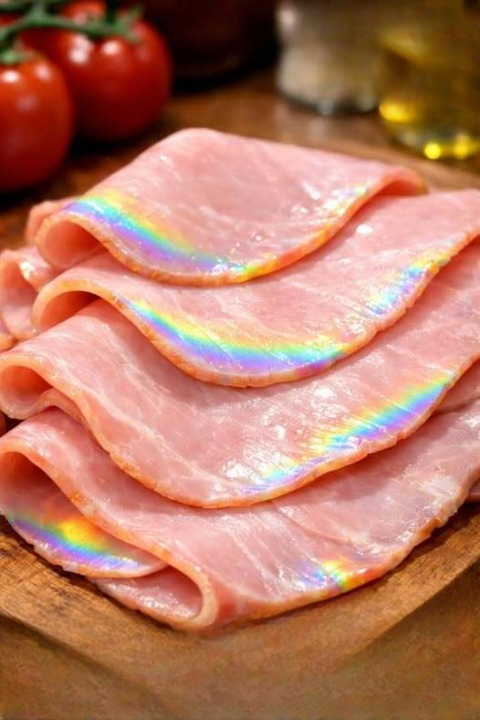
Have you ever opened a package of deli ham and noticed an unexpected rainbow-like shine across the surface?
Under certain lighting conditions, slices of ham can appear to display shades of green, blue, purple, or even silver. For many people, the sight is surprising. Some immediately wonder whether the meat has spoiled, been contaminated, or is no longer safe to eat.
After all, colorful reflections are not something most consumers expect to see on a slice of deli meat.
Fortunately, the explanation is often far less concerning than people imagine.
In many cases, the rainbow effect seen on ham and other processed meats is a natural optical phenomenon related to the structure of the meat and the way light interacts with its surface.
Understanding why this happens can help consumers make informed decisions and avoid unnecessary food waste.
Let’s take a closer look at the science behind rainbow-colored deli ham, how to distinguish normal visual effects from signs of spoilage, and what food safety experts recommend when evaluating packaged meats.
Why Rainbow Colors Appear on Ham
The colorful sheen occasionally seen on deli meats is commonly known as iridescence.
Iridescence occurs when light reflects off a surface in a way that separates it into different colors.
This same phenomenon can be observed in nature and everyday life.
Examples include:
- Soap bubbles
- Oil on water
- Peacock feathers
- Butterfly wings
- Compact discs (CDs)
- Certain minerals
In each case, the colors are not actually pigments within the object itself. Instead, they are created by the way light waves interact with microscopic structures.
The same principle can occur on sliced meat.
The Structure of Meat Matters
Ham contains muscle fibers that are arranged in specific patterns.
When meat is sliced, especially by commercial deli equipment, the cut surface can become extremely smooth.
This smooth surface reflects light in unique ways.
As light strikes the meat, it interacts with the microscopic arrangement of muscle fibers, moisture, and natural proteins.
Under certain lighting conditions, this interaction causes different wavelengths of light to separate and become visible as rainbow-like colors.
The effect is similar to how a prism separates white light into a spectrum of colors.
Why Processed Ham Shows the Effect More Often
Although iridescence can appear on various types of meat, it is particularly common in cured and processed products such as ham.
Several factors contribute to this.
Smooth Slicing
Commercial slicers create exceptionally even surfaces.
The smoother the cut, the more likely light is to reflect in a way that creates iridescent effects.
Moisture Content
Ham often retains moisture during processing.
Moisture can enhance light reflection and make color shifts more noticeable.
Muscle Structure
The organization of muscle fibers in ham creates conditions that may increase the visibility of rainbow patterns.
Curing Process
Curing methods can affect the texture and appearance of meat, making iridescence easier to observe under certain conditions.
Does Rainbow Coloring Mean the Ham Is Spoiled?
In many cases, no.
A rainbow appearance alone is not typically considered a reliable indicator of spoilage.
Food spoilage is generally identified through a combination of factors rather than color reflections alone.
Safe food evaluation involves considering:
- Expiration dates
- Storage conditions
- Odor
- Texture
- Appearance
- Packaging integrity
If the ham otherwise appears fresh and has been properly stored, the rainbow effect is often simply a harmless optical phenomenon.
Understanding the Difference Between Iridescence and Spoilage
This distinction is important because many consumers mistakenly assume unusual colors automatically indicate food safety concerns.
While some color changes can signal spoilage, iridescence behaves differently.
Iridescence
- Appears as shifting colors
- Changes depending on viewing angle
- Often resembles a rainbow
- Reflects light
- Usually appears on smooth surfaces
Potential Spoilage Indicators
- Unpleasant odor
- Sticky texture
- Excessive sliminess
- Significant discoloration
- Damaged packaging
- Mold growth
When evaluating food, it is important to consider the overall condition rather than focusing on a single visual characteristic.
Why Light Creates Different Colors
The science behind iridescence is fascinating.
White light contains multiple colors combined together.
When light encounters certain surfaces, it can scatter, reflect, and interfere with itself.
Different wavelengths reflect at slightly different angles.
As a result, observers see various colors depending on:
- Viewing angle
- Lighting conditions
- Surface texture
- Moisture levels
This explains why the rainbow effect may appear stronger under kitchen lighting, sunlight, or specific viewing positions.
Move the ham slightly, and the colors often shift or disappear.
Similar Effects in Other Foods
Ham is not the only food that can display iridescence.
Consumers occasionally observe similar effects on:
- Roast beef
- Turkey
- Bacon
- Fish
- Poultry products
In many cases, the explanation remains the same: light interacting with the microscopic structure of the food.
Understanding this can help prevent unnecessary concern when encountering unusual visual effects.
The Role of Food Processing
Modern food processing techniques are designed to improve consistency, quality, and shelf life.
During production, manufacturers carefully control:
- Temperature
- Moisture levels
- Slicing methods
- Packaging conditions
These processes can sometimes enhance the visibility of natural optical effects.
As a result, products may appear different from homemade meats even when both are perfectly safe.
Why Consumers Often Become Concerned
Human beings naturally rely on visual cues when evaluating food.
When something looks different from expectations, concern is understandable.
Our brains are designed to notice unusual details.
This tendency helps explain why rainbow-colored ham often attracts attention.
Many people associate unusual colors with spoilage because visual changes can sometimes indicate food quality issues.
However, not every unusual appearance signals a problem.
Education helps distinguish harmless characteristics from legitimate warning signs.
What Food Safety Experts Recommend
Food safety professionals generally encourage consumers to evaluate food using multiple factors.
Rather than focusing exclusively on appearance, experts recommend considering:
Storage Temperature
Keep refrigerated products at appropriate temperatures.
Packaging Condition
Avoid products with damaged or compromised packaging.
Expiration Dates
Follow “use by” and expiration guidelines provided by manufacturers.
Odor Assessment
Fresh deli meats should not produce strong unpleasant smells.
Texture Evaluation
Excessive sliminess or stickiness may indicate spoilage.
Combining these observations provides a more reliable assessment of food quality.
Preventing Unnecessary Food Waste
Food waste remains a significant issue worldwide.
Many perfectly safe foods are discarded because consumers misinterpret normal characteristics as signs of spoilage.
Understanding natural phenomena such as iridescence can help reduce unnecessary waste.
Before discarding food based solely on appearance, it is often helpful to consider:
- Storage history
- Packaging condition
- Expiration information
- Other signs of freshness
This approach promotes informed decision-making while reducing avoidable waste.
The Fascinating Science of Everyday Foods
One of the most interesting aspects of the rainbow ham phenomenon is how it reveals the hidden complexity of everyday foods.
Most people think of food primarily in terms of taste and nutrition.
Yet food also involves:
- Chemistry
- Physics
- Biology
- Engineering
- Material science
Even something as simple as a slice of deli ham can demonstrate sophisticated interactions between light and matter.
These scientific processes occur constantly, often without our awareness.
Why Lighting Makes a Difference
Have you ever noticed that the rainbow effect appears stronger in certain locations?
This happens because lighting conditions influence visibility.
Factors include:
- Brightness
- Angle of illumination
- Light source type
- Surface reflection
A package of ham may appear completely normal in one room and display noticeable iridescence in another.
This variation is further evidence that the effect is related to light rather than spoilage.
Consumer Awareness and Confidence
Knowledge helps consumers make better choices.
Understanding why rainbow colors appear on deli ham can reduce unnecessary concern and increase confidence when evaluating food products.
Rather than assuming the worst, informed consumers can examine the situation more carefully and make decisions based on multiple indicators.
This balanced approach supports both food safety and practical household management.
Common Questions About Rainbow Ham
Is the rainbow color caused by chemicals?
Not necessarily.
The effect is generally related to light interacting with the natural structure of the meat.
Does the color mean the ham is unsafe?
Not by itself.
Food safety should be evaluated using multiple factors.
Why does the color change when I move the slice?
Changing viewing angles alter how light reflects, causing the colors to shift.
Can fresh ham show iridescence?
Yes.
Freshly sliced products often display the effect more prominently.
Does cooking remove the rainbow appearance?
Sometimes.
Heat changes the structure of proteins and moisture levels, which may reduce visible iridescence.
Appreciating the Science Behind Everyday Foods
The next time you notice an unusual shimmer on deli ham, it may help to remember that nature and science often produce surprising visual effects.
What initially appears strange can often have a perfectly reasonable explanation.
Rather than being a warning sign, the rainbow sheen frequently represents a fascinating interaction between light and the microscopic structure of the meat.
Understanding these phenomena can transform concern into curiosity.
Final Thoughts
Seeing rainbow-colored deli ham for the first time can be surprising. Many consumers immediately assume something is wrong, but the colorful shine is often a natural optical effect known as iridescence.
This phenomenon occurs when light interacts with the meat’s smooth surface, moisture content, and microscopic structure, creating shifting rainbow-like colors. In most cases, the effect alone does not indicate spoilage or contamination.
As with any food product, consumers should evaluate overall quality by considering storage conditions, expiration dates, odor, texture, and packaging integrity.
Most importantly, understanding the science behind iridescence helps reduce unnecessary worry and prevents avoidable food waste.
Sometimes the most unusual things we notice in our kitchens are not signs of a problem at all—they are reminders of the fascinating science hidden within everyday life.