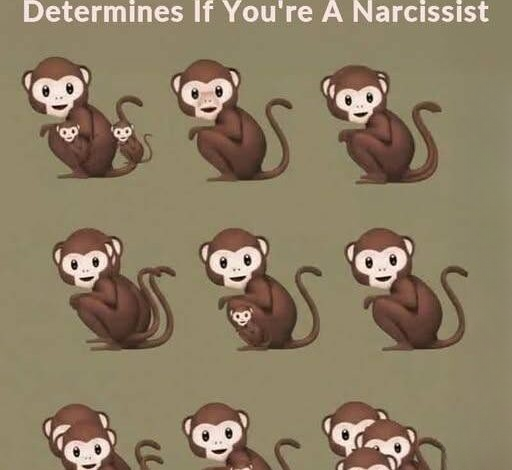
If you spend any time online, you have probably encountered one of those eye-catching visual puzzles that promise to reveal something extraordinary about your personality. They often appear with dramatic captions such as:
- “The Number of Animals You See Reveals Your Hidden Traits”
- “Only Highly Creative People Can Spot the Secret Image”
- “What You Notice First Exposes Your True Character”
- “This Optical Illusion Knows More About You Than Your Friends Do”
One of the most widely shared examples features a row of smiling cartoon monkeys arranged in a seemingly simple illustration. At first glance, the image appears straightforward, but viewers quickly discover that different people report seeing different numbers of monkeys. The accompanying claim usually suggests that the number you count can somehow reveal whether you are self-focused, highly confident, exceptionally observant, or possess other personality characteristics.
Millions of people have shared similar images across social media platforms, generating endless debates in comment sections. Friends compare answers. Family members challenge each other. Strangers argue about what the image means.
But does an optical illusion really have the power to uncover hidden aspects of your personality?
The answer is far more interesting than most viral posts suggest.
Rather than exposing a secret character trait, these images reveal something equally fascinating: the remarkable way the human brain processes visual information.
Why We Are Drawn to Personality Quizzes
Humans have always been curious about themselves.
For centuries, people have searched for ways to better understand their thoughts, behaviors, strengths, and weaknesses. From ancient philosophies to modern psychology, the desire for self-discovery has remained constant.
Today, the internet has transformed that curiosity into an endless stream of quick personality assessments.
Why are these quizzes so appealing?
The answer lies in several psychological factors.
We Love Learning About Ourselves
Research consistently shows that people enjoy receiving information that feels personally relevant.
Even when information is vague, our brains naturally search for ways to connect it to our experiences.
This tendency makes personality quizzes extremely engaging because they place us at the center of the story.
Instead of learning about a distant topic, we are learning about ourselves.
At least, that is what the quiz promises.
We Enjoy Quick Answers
Real self-discovery can take years.
Understanding personality involves reflection, experience, and honest evaluation.
Viral quizzes offer something much simpler.
They promise immediate insights within seconds.
All you have to do is look at an image, answer a question, and receive a result.
That simplicity is incredibly attractive.
Social Sharing Makes It More Fun
Many illusion-based tests become popular because they create instant conversation.
When one person sees six monkeys and another sees nine, curiosity naturally follows.
People want to compare answers.
This social element helps these images spread rapidly across platforms.
Understanding Optical Illusions
Before exploring why people see different numbers of monkeys, it helps to understand what optical illusions actually are.
An optical illusion occurs when the information received by your eyes is interpreted differently than expected by your brain.
In simple terms, your eyes collect visual data, but your brain determines what that data means.
Sometimes the interpretation is not as straightforward as it appears.
This can create surprising visual experiences.
Your Brain Is Constantly Making Predictions
Many people assume vision works like a camera.
In reality, vision is far more complex.
Your brain is constantly making educated guesses about the world around you.
It fills gaps.
It predicts patterns.
It simplifies information.
It organizes shapes into meaningful objects.
This process happens so quickly that we rarely notice it.
Most of the time these predictions are incredibly accurate.
Occasionally, however, an illusion exposes the shortcuts our brains use.
Why Different People See Different Things
One of the most fascinating aspects of optical illusions is that they often produce different results among viewers.
Several factors contribute to these differences.
Attention
Your attention determines where you focus first.
If your eyes are drawn toward one section of an image, you may interpret the picture differently from someone who begins elsewhere.
Small differences in focus can dramatically change perception.
Experience
Past experiences influence what we notice.
Someone familiar with visual puzzles may immediately search for hidden patterns.
Another person may focus on the most obvious shapes first.
These habits affect what each viewer reports seeing.
Expectations
Expectations can shape perception.
If you are told there are multiple monkeys hidden in an image, your brain begins actively searching for them.
If you are told the image contains only a few monkeys, you may stop looking sooner.
This demonstrates how powerful expectations can be.
Visual Processing Styles
People naturally process visual information differently.
Some focus on details.
Others focus on overall patterns.
Neither approach is better or worse.
They simply reflect different ways of interpreting visual information.
The Monkey Illusion Explained
The viral monkey illustration relies on overlapping visual elements.
Some monkeys are obvious.
Others are formed by combining shapes, outlines, or partial features.
Depending on how carefully you examine the image, you may identify different numbers of figures.
This does not mean one person is smarter than another.
Nor does it indicate a particular personality type.
Instead, it reflects how visual information is organized and interpreted.
The illusion is designed to encourage multiple valid interpretations.
That ambiguity is what makes it so engaging.
Why Viral Posts Make Dramatic Claims
If optical illusions do not actually diagnose personality traits, why do so many posts claim otherwise?
The answer is simple.
Dramatic claims attract attention.
A headline stating:
“Interesting Visual Puzzle Demonstrates Human Perception”
would probably receive far fewer clicks than:
“Discover Your Hidden Personality Trait in Seconds.”
The internet rewards engagement.
As a result, many creators use bold language to encourage sharing.
These claims are often intended for entertainment rather than scientific evaluation.
The Psychology of Believing Personality Results
An interesting phenomenon occurs when people read personality descriptions.
Even very general statements can feel surprisingly accurate.
Psychologists have studied this effect for decades.
The Barnum Effect
The Barnum Effect describes our tendency to accept broad descriptions as uniquely applicable to ourselves.
For example:
- You value close relationships.
- You sometimes doubt your decisions.
- You enjoy recognition for your accomplishments.
- You occasionally feel misunderstood.
Most people can relate to these statements.
Because they feel personal, they seem highly accurate.
Many viral personality quizzes rely on this principle.
The results are often broad enough that almost anyone can identify with them.
What Science Says About Personality
Modern psychology approaches personality very differently from internet quizzes.
Researchers use carefully designed assessments that undergo extensive testing.
These tools examine patterns across large populations and evaluate reliability over time.
One of the most widely recognized frameworks is known as the Big Five personality model.
This model measures characteristics such as:
- Openness
- Conscientiousness
- Extraversion
- Agreeableness
- Emotional stability
These dimensions are assessed through detailed questionnaires rather than quick visual puzzles.
While no personality assessment is perfect, scientific methods aim to provide more reliable insights than a single image viewed for a few seconds.
Why Optical Illusions Remain Valuable
Even though illusions may not reveal hidden personality traits, they remain incredibly useful.
They teach us important lessons about perception.
They Demonstrate Brain Efficiency
Your brain processes enormous amounts of information every second.
Without shortcuts, everyday tasks would be overwhelming.
Illusions reveal how efficiently the brain organizes visual input.
They Highlight Individual Differences
No two people experience the world in exactly the same way.
Illusions remind us that perception can vary from person to person.
This diversity is one reason human thinking is so fascinating.
They Encourage Curiosity
Visual puzzles inspire questions.
How does vision work?
Why do we see different things?
How does the brain create reality?
These questions lead to deeper understanding.
The Role of Social Media in Viral Illusions
Social media has transformed optical illusions into global phenomena.
A puzzle posted in one country can reach millions of viewers worldwide within hours.
Several factors contribute to this rapid spread.
Instant Participation
People can engage immediately.
No special knowledge is required.
All they need is a few seconds and a willingness to look closely.
Easy Sharing
Users enjoy challenging friends.
A simple comment such as “How many monkeys do you see?” encourages interaction.
Emotional Reactions
Surprise drives engagement.
When viewers discover others see something different, curiosity increases.
That emotional response fuels sharing.
What Your Response Might Actually Reveal
Although the monkey illusion cannot diagnose personality, your reaction to the puzzle may offer interesting clues about your habits.
For example:
Did You Look Quickly?
You may prefer fast decision-making.
Did You Study Every Detail?
You might enjoy careful analysis.
Did You Compare Answers With Others?
You may value collaboration and discussion.
Did You Research the Science Behind It?
You may have a naturally curious mindset.
Notice that these observations focus on behavior rather than assigning labels.
They reflect choices rather than fixed personality categories.
How Perception Shapes Everyday Life
The lessons from optical illusions extend far beyond internet entertainment.
Perception influences countless daily experiences.
Communication
People can hear the same conversation and interpret it differently.
Memory
Two individuals may remember the same event in different ways.
Decision-Making
Different perspectives often lead to different conclusions.
Understanding these variations can improve empathy and communication.
When we recognize that perception is flexible, we become more open to other viewpoints.
The Fascinating Relationship Between Eyes and Brain
Many people assume seeing occurs entirely in the eyes.
In reality, the eyes collect information, but the brain performs much of the interpretation.
Visual signals travel through complex neural pathways where they are analyzed and organized.
The brain identifies:
- Shapes
- Colors
- Movement
- Depth
- Patterns
This process happens almost instantly.
Optical illusions provide rare opportunities to observe these mechanisms in action.
They reveal that seeing is not simply recording reality.
It is actively constructing an interpretation of reality.
Why Some People Love Visual Puzzles
Certain individuals are naturally drawn to illusions and brain teasers.
Several factors may explain this attraction.
Curiosity
People enjoy solving mysteries.
Pattern Recognition
Humans are naturally skilled at finding patterns.
Mental Stimulation
Puzzles provide a rewarding cognitive challenge.
Social Interaction
Sharing results creates conversation and connection.
These benefits help explain why optical illusions remain popular across generations.
Separating Entertainment From Evidence
The most important lesson from viral personality images is learning to distinguish entertainment from scientific evidence.
There is nothing wrong with enjoying a visual puzzle.
In fact, they can be fun, educational, and thought-provoking.
Problems arise only when entertainment claims are mistaken for established facts.
A cartoon image cannot diagnose complex personality traits.
Human behavior is far too nuanced for such simple conclusions.
True personality assessment requires careful observation, validated research methods, and consideration of many factors.
The Real Mystery Is Even More Amazing
Ironically, the truth behind the monkey illusion may be more fascinating than the viral claim itself.
The image does not reveal a hidden personality label.
Instead, it showcases one of the most extraordinary systems ever known: the human brain.
Every second, your brain performs calculations so sophisticated that modern computers still struggle to replicate them fully.
It identifies faces in crowds.
Recognizes objects instantly.
Predicts movement.
Interprets emotions.
Processes language.
And somehow transforms patterns of light into the rich visual world you experience every day.
That achievement is far more remarkable than any social media personality test.
Final Thoughts
The next time you encounter a viral image claiming to expose a hidden trait or reveal your true character, approach it with curiosity rather than certainty.
Enjoy the challenge.
Compare answers with friends.
Explore the illusion.
But remember that the most interesting discovery may not be what the image supposedly says about you.
Instead, it is what the experience reveals about the incredible complexity of human perception.
The monkey illusion is not a secret personality detector.
It is a reminder that our brains are constantly interpreting, predicting, and constructing the world around us.
And that remarkable process is far more impressive than any headline promising a quick glimpse into your inner self.
So whether you spotted three monkeys, six monkeys, nine monkeys, or even more, the real takeaway remains the same: the human mind is endlessly fascinating, and understanding how we see the world is one of the greatest puzzles of all.