What You Notice First in This Optical Illusion Says More About Perception Than Personality
Optical illusions have fascinated people for generations.
They challenge our assumptions, test our observation skills, and remind us that seeing is not always as straightforward as it seems.
A single image can produce multiple interpretations, leading different viewers to notice completely different details despite looking at the exact same picture.
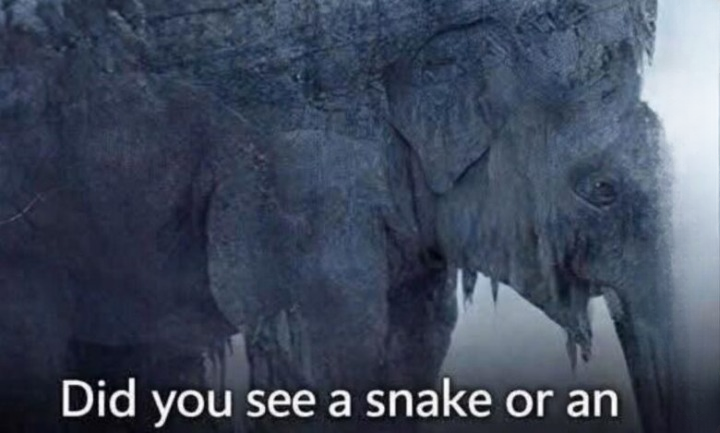
Recently, a visual puzzle featuring an icy landscape has attracted widespread attention online.
Some viewers immediately notice the shape of a snake winding across the scene.
Others quickly identify what appears to be the profile of an elephant hidden within the frozen landscape.
The image has sparked countless discussions as people compare what they saw first and attempt to understand why different observers reach different conclusions.
While some internet posts suggest these illusions reveal hidden personality traits, psychologists and vision researchers generally explain them differently.
In reality, these fascinating images provide insight into how the human brain processes information, recognizes patterns, and interprets visual details.
Why Optical Illusions Fascinate Us
The human brain receives enormous amounts of visual information every second.
If the brain attempted to analyze every detail individually, processing would become overwhelming.
Instead, the brain relies on shortcuts.
It quickly organizes shapes, colors, shadows, and patterns into meaningful objects.
Most of the time, this system works remarkably well.
However, optical illusions demonstrate that perception is not always a direct reflection of reality.
Instead, perception is an interpretation created by the brain.
This is what makes illusions so interesting.
They reveal the difference between what exists in an image and how our minds choose to interpret it.
The Icy Landscape Illusion
At first glance, the image appears to show a snowy, frozen environment.
Rock formations, shadows, and patches of snow combine to create a complex visual scene.
However, hidden within that scene are multiple recognizable shapes.
Some viewers immediately identify:
A Snake
The winding shape appears to stretch across the landscape, creating the impression of a long reptile moving through the snow.
Others notice:
An Elephant
The contours of the rock and ice can resemble an elephant’s head and trunk.
Both interpretations are present within the image.
The challenge lies in determining which one your brain notices first.
Why People See Different Things
One of the most fascinating aspects of visual perception is that people often focus on different details.
Several factors may influence what someone notices first:
Prior Experiences
Previous exposure to certain shapes, animals, or environments can influence recognition.
Visual Attention
People naturally focus on different parts of an image.
Pattern Recognition
The brain constantly searches for familiar forms and objects.
Contrast and Detail
Certain features may stand out more prominently to some viewers than others.
Because every person’s experiences and attention patterns differ slightly, different interpretations are completely normal.
The Science of Pattern Recognition
Humans are exceptionally skilled at recognizing patterns.
This ability helped our ancestors identify:
- Animals
- Food sources
- Environmental hazards
- Social cues
Over time, the brain evolved to quickly detect familiar shapes, even when visual information is incomplete.
This process is known as pattern recognition.
Optical illusions often take advantage of this ability by presenting information that can be interpreted in multiple ways.
The brain fills in missing details and creates a meaningful image.
Understanding Ambiguous Images
Images that support multiple interpretations are sometimes called ambiguous figures.
These visuals contain elements that allow viewers to switch between different perceptions.
Famous examples include:
- The duck-rabbit illusion
- The vase-faces illusion
- The old woman-young woman illusion
The snake-and-elephant image belongs to this category.
Neither interpretation is incorrect.
The image simply supports more than one way of seeing it.
Why We Can’t Always See Both Images Immediately
Many people find it difficult to notice the second image after identifying the first.
This occurs because the brain tends to settle on one interpretation.
Once a pattern is recognized, attention becomes focused on maintaining that perception.
However, with patience and observation, most viewers can eventually identify both animals.
This process demonstrates the flexibility of human perception.
Optical Illusions and the Brain
Optical illusions are valuable tools for researchers.
Scientists study them to better understand:
- Visual processing
- Attention
- Perception
- Decision-making
- Brain function
By examining how people interpret ambiguous images, researchers gain insights into how the brain organizes information.
These studies contribute to broader knowledge about cognition and human behavior.
Do Optical Illusions Reveal Personality?
Many viral posts claim that what you notice first reveals hidden personality traits.
For example:
- Seeing one object supposedly means you’re analytical.
- Seeing another supposedly means you’re creative.
- Different interpretations are often linked to leadership, intelligence, or emotional characteristics.
While these claims are entertaining, there is generally little scientific evidence supporting such conclusions.
Most psychologists agree that what people notice first is more closely related to visual attention and perception than to fixed personality traits.
That does not make the activity less enjoyable.
It simply means the results should be viewed as fun observations rather than formal psychological assessments.
Why People Enjoy Visual Challenges
Visual puzzles remain popular because they engage several parts of the brain simultaneously.
They encourage:
- Observation
- Curiosity
- Problem-solving
- Focus
- Critical thinking
Many people enjoy the moment when a hidden image suddenly becomes visible.
That experience creates a sense of discovery and accomplishment.
The Relationship Between Perception and Reality
Optical illusions highlight an important lesson:
Our perception is not always identical to reality.
The brain continuously interprets incoming information.
In most situations, those interpretations are highly accurate.
However, illusions remind us that perception involves active processing rather than passive observation.
This insight has implications far beyond visual puzzles.
It influences how we understand memory, communication, and decision-making.
The Benefits of Challenging Your Brain
Activities that encourage observation and critical thinking can be mentally stimulating.
Examples include:
- Puzzles
- Visual challenges
- Logic games
- Reading
- Learning new skills
These activities promote engagement and curiosity.
Optical illusions provide a particularly enjoyable way to explore how the brain works.
Looking Beyond the First Impression
One of the most valuable lessons from ambiguous images is the importance of considering multiple perspectives.
The first interpretation may not be the only one.
The same principle often applies in everyday life.
Whether evaluating information, solving problems, or communicating with others, remaining open to alternative viewpoints can lead to deeper understanding.
Optical illusions offer a simple reminder of that idea.
How to Train Your Observation Skills
If you enjoy visual puzzles, several habits may help improve observation:
Slow Down
Spend extra time examining details.
Change Your Focus
Look at different parts of the image.
Step Back
Viewing from a different distance may reveal new patterns.
Remain Open-Minded
Avoid becoming attached to a single interpretation.
These techniques can make hidden images easier to identify.
Why Optical Illusions Remain Popular
Despite advances in technology and science, optical illusions continue to capture public attention.
Their appeal is universal.
They are accessible, entertaining, and thought-provoking.
Most importantly, they reveal something fascinating about the human mind:
Even when people look at the same image, they may experience it differently.
That diversity of perception is part of what makes human cognition so remarkable.
Final Thoughts
The snake-and-elephant illusion is a perfect example of how the brain interprets visual information.
While the image may not reveal secret personality traits or hidden aspects of character, it does provide a fascinating glimpse into perception, attention, and pattern recognition.
Whether you noticed the snake first, the elephant first, or struggled to see either one initially, your experience reflects the incredible complexity of the human brain.
Optical illusions remind us that seeing is not simply about looking.
It is about interpretation.
And sometimes, the most interesting discoveries occur when we realize there is more than one way to view the same picture.
That lesson extends far beyond any illusion and into the way we understand the world itself.